Steel logistics is a specialized discipline that demands heavy-duty engineering and precision timing under rigorous safety protocols. In modern supply chains, where manufacturers, fabricators, and construction firms operate on razor-thin margins and lean inventory models, the movement of steel becomes the heartbeat of the entire operation. A missed delivery window in a typical freight operation is an inconvenience; in a steel supply chain, it is a catastrophic failure. A delayed coil shipment can halt an automotive assembly line, delay a multi-million dollar infrastructure project, and generate secondary cost overruns that ripple far beyond the warehouse dock.
Samee Metal Trading operates out of Hamilton, Ontario as a steel supplier and carrier. Our family has worked with metal products for over thirty years across three generations, and we serve customers throughout Canada and the U.S.A. This expanded guide explores the intricacies of steel transport, the technical requirements of high-capacity freight, and why specialized assets are the only way to guarantee supply chain integrity.
Why Steel Coil Transport Requires Specialized Freight Equipment
Steel coils, sheet metal, and structural products concentrate extreme weight into small footprints, which rules out the trailers, straps, and habits that work fine for general freight. Steel almost never moves by air freight; the weight rules it out, so road transportation and rail terminals handle nearly all of this cargo movement. General carriers struggle in this sector for reasons rooted in physics, and it helps to look at the load itself.
The Physics of Density and Load Distribution
Steel coils sit among the densest freight categories in existence. A trailer full of consumer electronics or palletized food spreads its weight fairly evenly across the floor. A single coil pushes several tons through one small contact patch, and this point loading can exceed the structural limits of a standard trailer floor, causing it to sag or fail outright.
The center of gravity changes too. A coil placed even a few inches off-center can produce dangerous listing during turns and uneven tire wear over distance. Drivers hauling steel freight need training in weight distribution so the load stays stable through highway speeds and sudden braking.
Specialized Decking and Securing Systems
General-purpose flatbeds are often insufficient for high-volume steel work. Purpose-built steel trailers carry coil racks and heavy-duty cradles that keep the coil from rolling. Securement comes from high-tensile chains and binders rated for far higher break-strengths than standard polyester straps. Our equipment at Samee Metal Trading is selected specifically for these high-tension requirements, so the cargo stays bonded to the chassis even under rough road conditions.
Environmental Protection and the Tarping Dilemma
Steel degrades quickly when exposed. Rain, road salt, or even high humidity during transit can trigger white rust or surface oxidation, which can render a coil unusable for surface-sensitive applications like automotive body panels, appliance manufacturing, or the finished grades handled by stainless steel suppliers. General carriers often rely on manual tarps prone to tearing and improper sealing. Specialized steel fleets run retractable Conestoga-style tarping systems that create a weather-tight seal in seconds, protecting surface integrity from the warehouse door until the coil is craned into the customer's manufacturing facility.
Why Companies Choose a Fleet Built for Steel
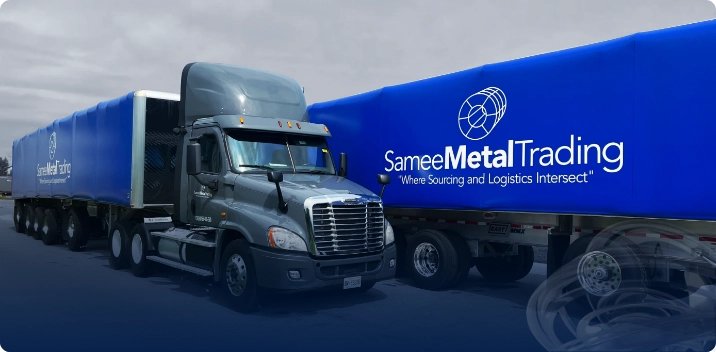
Our in-house fleet runs ten high-performance assets, eight 5-axle flatbed trucks and two B-trains, all chosen for the regulatory and physical demands of North American steel hauling. Maintaining a 99.98% accuracy rate requires hardware as dependable as the systems behind it, which is why our trucking and freight division was built around these configurations.
The Power of the 5-Axle Configuration
The 5-axle flatbed is the workhorse of the steel industry, and we operate eight of them. Five axles spread the massive weight of steel products such as coils and structural beams across more pavement, which keeps every load within Department of Transportation (DOT) and provincial Ministry of Transportation (MTO) per-axle weight limits. The same distribution gives the cargo a smoother ride, cutting the vibration fatigue that can cause surface abrasions on tightly wound coils.
High-Capacity Logistics: The B-Train Advantage
For high-volume requirements, we run two B-train trucks. A B-train links two trailers through a fifth wheel, allowing significantly more weight than a single-trailer setup, which suits large industrial projects and the replenishment of high-capacity service centers. Hauling large volumes in one trip also cuts transportation costs and fuel costs over long distances. Operating B-trains demands a higher tier of driver certification and mechanical maintenance, a standard our logistics operations are built to sustain.
The Invisible Risks of the Wrong Logistics Partners
When a procurement team chooses a carrier based solely on the lowest shipping costs per mile, they are often unknowingly accepting hidden logistics costs and a massive amount of risk. In steel logistics, the cheap option is frequently the most expensive in the long run.
Structural damage to the product
A driver who does not understand suicide versus shotgun loading positions, meaning the orientation of the coil eye, can cause irreparable damage to the steel's internal structure during loading or unloading.
The paperwork trap
Steel is a heavily regulated commodity. An inaccurate Bill of Lading, a missing weight scale ticket, or bad customs documentation on cross-border shipments can get a load impounded at the border or a weigh station. One bad file can trigger audits that disrupt shipments for months.
Safety and liability
A shifting steel load is a serious road hazard. Companies that hire cut-rate carriers can end up in vicarious liability lawsuits after an improperly secured load causes an accident. An asset-based fleet like ours, backed by rigorous safety standards and comprehensive insurance coverage, closes off that exposure.
Sound freight management starts with knowing these failure points exist, and reliable logistics partners plan around them.
How Warehousing, Trucking, and Logistics Services Work Together
Owning both the warehouse and the trucks removes the gaps that plague the traditional model, where a customer books storage and logistics providers separately from the mill order and hopes the handoffs line up. Every added party creates another point of failure and another blind spot in the chain. Our 3PL warehousing facility in Hamilton sits under the same roof as our dispatch, so the handoffs disappear.
Fifteen-Minute Dispatch to Meet Customer Expectations
When an order is processed, our dispatch team coordinates with warehouse operations in real time, which gets us to an average dispatch confirmation of just fifteen minutes. General carriers can take four to six hours to return a phone call. For a customer facing a line-down situation, that gap is the difference between a same-day truck and a lost shift with disrupted production schedules.
24/7 Inventory Management and Logistics Visibility
Our customers never have to guess where their steel is. Integrated inventory management gives them 24/7 remote access to inventory levels, and they can monitor shipments from our dock to the final destination. When a truck leaves our facility, the Bill of Lading is generated automatically from the same database that tracks the inventory, so the physical load matches the digital record every time. This level of data integrity has carried us through more than 960 million tons of steel delivered with near-perfect accuracy.

Contact us for all your steel needs
Build a Resilient Steel Supply Chain with Samee Metal Trading
Choosing who handles your steel freight is a strategic decision for an efficient supply chain. Manufacturing keeps moving toward high-strength alloys and thinner gauges, and the margin for error in steel transportation keeps shrinking with them. A 50,000-pound coil is a precision-engineered product that needs a 5-axle specialized environment to arrive in usable condition.
From standard hot-rolled coils to sensitive pre-painted Galvalume, Samee Metal Trading brings the specialized equipment, certified drivers, and integrated technology that keep production lines fed. With ten dedicated assets on the road and thirty years of specialized experience behind them, we move your business forward. Reach out to our team for full truckload quotes, coil freight scheduling, or combined warehousing and delivery. Contact Samee Metal Trading and our experienced team members will follow up.